Do you start your day with caffine, maybe you do and you just havent realized it whether its a quick run to starbucks, your favorite energy drink or a cup of coffee, all of these are sources of caffine. In the United States, about 75% of adults drink coffee, that means that about two-hundred million people drink coffee in just the United States. And if that many people are drinking coffee it must be a good thing right?
Caffine is identified as a stimulant and according to the U.S. Food and Drug Administration (FDA) caffine is a stimulant drug and consumption should be limited to a maximum intake of 400 mg a day. Does this mean the number one most consumed drug/additive in the world is bad for you? Not necessarily.
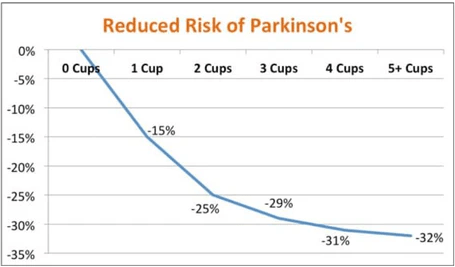
(Image credit https://www.healthline.com/nutrition/6-graphs-that-convince-you-to-drink-more-coffee)
Positives
Caffeine in moderation can have many health benefits, though not all of these benefits are confirmed.
Caffeine is known to improve alertness and attentiveness. As little as a 160 mg dosage can enhance mental alertness, speed reasoning, and improve memory. Infact Doorenbos et al. (1990) found that in rested, moderate caffeine users that attempted to consume 250-mg doses twice a day compared to placebo improved daytime alertness and reaction time on auditory vigilance tasks. Caffeine also boosts physical performance in sports and promotes weight loss by suppressing appetite and reducing the desire to eat, therefore preventing weight gain. According to the National Library of Medicine states that the effect of caffine can be quite prominent within excersize boosting output quite noticeably especially if the intake is high and the intensity is low, since most exercise response exceeds the actual effects from the caffine.
Studies confirm that coffee drinkers are less likely to die from coronary heart disease, stroke, diabetes, and kidney disease. Consuming coffee reduces the likelihood of developing type 2 diabetes, Parkinson’s disease, and heart failure while also lowering the odds of colon cancer and stroke. Additionally, dark roast coffee decreases breakage in DNA strands, which naturally occur but can lead to cancer or tumors if not repaired by your cells.
Alongside these benefits, caffeine may also help prevent the development of Alzheimer’s disease and support liver and colon health. It aids in maintaining healthy liver enzyme levels and promotes the excretion of bile through the colon wall, improving overall liver and colon function.
Negatives
While there are many benifits there are also a plethora of hidnerances. For example a high intake of caffeine can cause anxiety, insomnia, increased heart rate, jitters, headaches, stomach upset, dehydration, dependence, and potential worsening of existing health conditions like high blood pressure. It can also disrupt sleep patterns, especially when consumed in large quantities above the recommended 400 mg daily limit.
Regular caffeine consumption can lead to addiction, and if one stops consuming coffee daily, they may experience withdrawal symptoms such as headaches, fatigue, drowsiness, irritability, anxiety, nausea, and difficulty sleeping.
Takeaways
While caffeine can have positive effects on one’s health and be extremely helpful for staying awake when you feel drowsy, it also has many negative side effects. If you start to notice these negative effects, you should either reduce your daily caffeine intake or cut it out entirely. However then comes the issue of withdrawal symptoms, overall coffee can be both a superpower and nusiance.
Sources:
U.S. Food and Drug Administration. “Spilling the Beans: How Much Caffeine Is Too Much?” FDA, 29 Dec. 2023, www.fda.gov/consumers/consumer-updates/spilling-beans-how-much-caffeine-too-much.
Gunnars, Kris. “Caffeine Withdrawal: Symptoms, Timeline, & How to Cope.” Healthline, 3 Oct. 2018, www.healthline.com/nutrition/caffeine-withdrawal-symptoms.
Hopkins Medicine. “9 Reasons Why the Right Amount of Coffee Is Good for You.” Johns Hopkins Medicine, www.hopkinsmedicine.org/health/wellness-and-prevention/9-reasons-why-the-right-amount-of-coffee-is-good-for-you.
Medical News Today. “What Are the Benefits of Coffee?” Medical News Today, 25 Sept. 2018, www.medicalnewstoday.com/articles/285194#benefits.
Medical News Today. “What Are the Risks of Coffee?” Medical News Today, 25 Sept. 2018, www.medicalnewstoday.com/articles/285194#risks.
Mitchell, D. C., et al. “Beverage Caffeine Intakes in the U.S.” Food and Chemical Toxicology, vol. 63, 2014, pp. 136-142, PubMed Central, doi:10.1016/j.fct.2013.10.042.
National Research Council (US) Committee on Military Nutrition Research. Caffeine for the Sustainment of Mental Task Performance: Formulations for Military Operations. Washington (DC): National Academies Press (US); 2001. [Chapter 3: Efficacy of Caffeine]. Available from: https://www.ncbi.nlm.nih.gov/books/NBK223791/

 The Health Policy Journal
Leave a comment